Houston, TX · Garage Door Service
Garage door repair for Bellaire homes built around 1995, priced against a $236,311 median household income. Springs, openers, and panels fixed from our Houston crew.
Bellaire's median household income sits at $236,311, well above the $89,442 median across our wider Houston service area. That gap matters for one reason: it changes where the repair-or-replace line falls. On a lower-income block, a homeowner facing a $600 spring-and-cable job on a door that's already dented and 20 years old will often just replace the whole unit rather than sink money into it twice. In Bellaire, the math runs the other way more often. A sound door with good panels and a straight track is worth fixing even when the repair bill climbs, because the alternative - full replacement - costs more than most owners here need to spend on a door that isn't actually failing. We tell people straight when a repair won't hold, but we're not pushing you toward a new door just because your street can afford one. If the opener is dead and the springs are original, that's a repair call, not a replacement call, at this income level.
We travel from Houston, about 7 miles out, for every call here. There's no local branch and no on-site inventory sitting in Bellaire - what we carry is what's on the truck, which shapes which jobs get finished same-visit and which need a return trip for a part.
Bellaire's housing stock centers on 1995, newer than a lot of the close-in Houston area, which sits more broadly across the 1956-2006 range with a median around 1986. That later build year means fewer of the original steel one-piece doors and more sectional doors on standard torsion springs - the kind of hardware that's easier to source parts for but still fails the same three ways: the spring goes, the opener's drive gear strips, or the bottom roller track works loose from the jamb over enough open-close cycles.
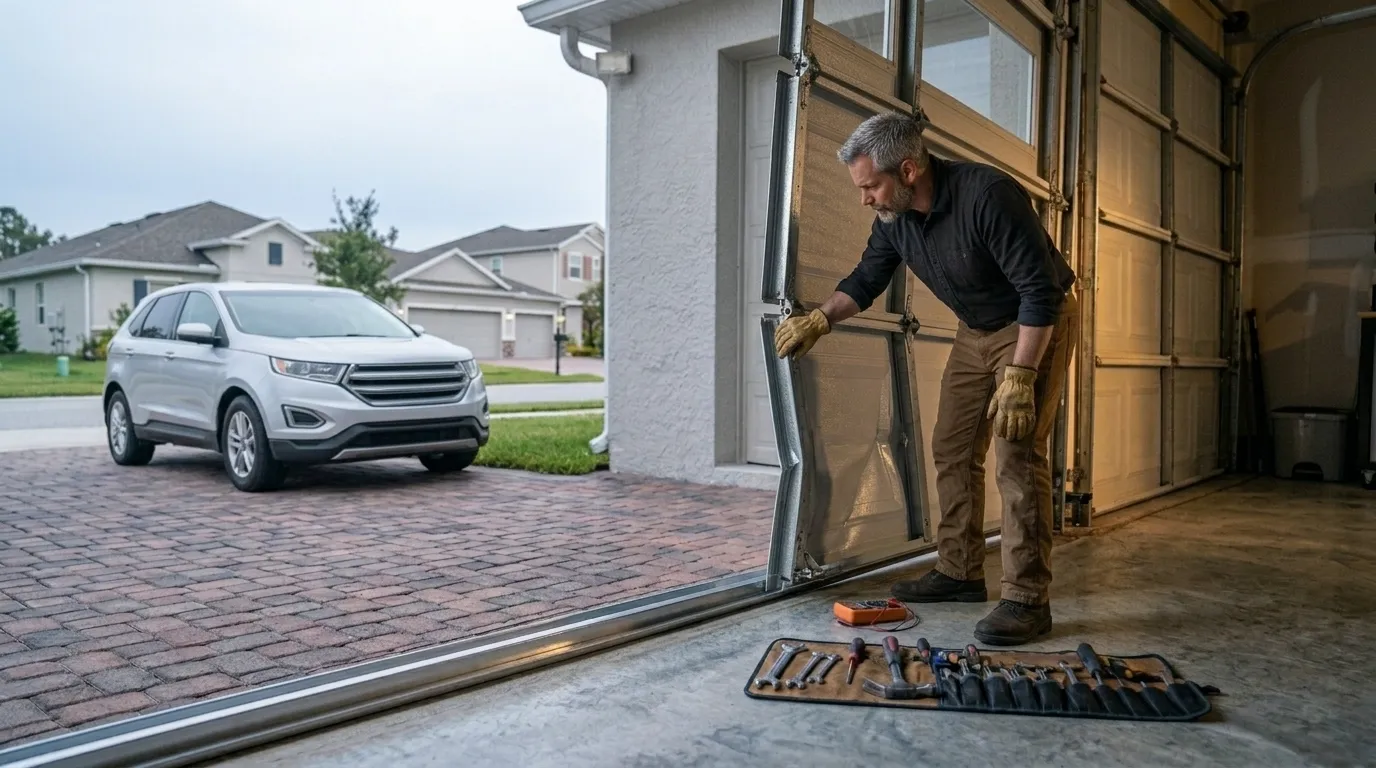
What you'll usually notice first is the door hesitating partway up, or the opener motor running while the door doesn't move. Sometimes it's a loud bang from the garage - that's almost always a spring letting go, not the opener. On a 1995-era door, the springs are old enough now to be near or past their cycle life even if nothing else on the house has been touched. If the door drops fast or won't stay up on its own, don't force it by hand; that's spring tension doing the work it was built to do, and it can move fast when it fails.
For a broken torsion spring, the job is pulling both springs (we replace in pairs on a double door even if only one broke - the other is close behind it), setting the new spring to the correct wind for your door's weight, and running the door through a full cycle to check balance. On a strut-reinforced sectional door, common on houses from the 1990s, we also check the top panel for stress cracks where the strut bolts through, since that's a point that takes the most load.
Opener repairs are a different job entirely - usually a gear-and-sprocket kit if the motor runs but the door doesn't move, or a full logic board swap if the opener won't respond to the wall button or remote at all. We test the safety reversal sensors on every opener job regardless of what brought us out, because a door that doesn't reverse when it hits something is a repair we won't leave unfinished. We don't chase every rattle in a track with a full rail replacement - most track noise on a house this age is a loose bracket, not a bent rail, and we'll tell you which one it is before quoting anything.
The climate here runs mild with occasional freeze, not the deep freeze-thaw cycling that cracks concrete aprons or seizes hardware further north. That works in Bellaire's favor - springs and cables don't see the same metal fatigue from temperature swings that colder-climate doors do. What still gets these doors, on houses built around 1995, is straight mileage: a two-car household running the door multiple times a day for close to three decades puts a spring through its full cycle count even without weather doing any of the damage.
Humidity is the other factor. Houston-area humidity, even without hard freezes, works on unlubricated hardware and steel rollers over time, especially on the north-facing side of a garage that doesn't get much sun to dry it out. We see more roller and hinge wear from that than from anything cold does. It's not dramatic, it's just steady - which is why a door that's never been serviced since it was installed in the mid-90s is usually the one that fails without warning.
The truck carries standard torsion springs in the sizes that fit most sectional doors from the 1980s through 2000s, along with rollers, cables, hinges, and the common opener drive components - gear-and-sprocket kits, logic boards for the major opener brands, and safety sensor pairs. That covers the large majority of what breaks on a Bellaire-era door.
What we don't stock is anything custom - a non-standard panel size, a discontinued opener model, or hardware for a door that's been modified from its original build. If your door needs a part like that, we'll tell you on the visit and give you a real timeline instead of guessing, because ordering a specialty part can add days we can't shorten. That's the one honest limit on same-day work: common parts get fixed on the spot, uncommon ones don't.
A standard spring or cable repair is a same-visit job once we're on-site - the door goes back into full working order before we leave. Opener repairs run the same way if the part is one we carry on the truck. Where you're without a working door longer is the specialty-part case above: if we have to order something, the door can usually be left secured and operable by hand in the meantime, but full automatic function waits on the part arriving.
Because we're coming from Houston, about 7 miles away, the drive itself isn't the bottleneck - it's whether the fix needs a part that isn't standard stock. For the common failures on a house built around 1995 - spring, cable, roller, standard opener gear - that's not usually a concern.
Usually worth repairing. A door from that era is generally sectional steel on standard torsion hardware, which we carry parts for. If the panels are straight and the track isn't bent, a spring or opener repair costs a fraction of full replacement and gets you the same working door.
No. We run out of Houston, about 7 miles away, and cover Bellaire on scheduled visits. There's no on-site depot here, so what fixes the job same-day is whatever's already stocked on the truck.
Torsion springs fail by cycle count, not by age alone. A door run several times a day for close to three decades reaches the end of its spring's rated cycles eventually, and it usually lets go without much warning - that's the spring doing its job at the end of its life, not a sign of neglect.
Yes, more than the mild winters do. Steady humidity works on unlubricated rollers and hinges over years, especially on a garage side that doesn't get much direct sun. It's a slower cause of failure than cold-climate freeze-thaw, but it adds up the same way over a couple of decades.
Call now or request a free quote - same-day service on most repairs, upfront written pricing.