Houston, TX · Garage Door Service
West University Place homes went up mostly in the early 1990s. That means specific springs, openers, and tracks - here's what we see and carry on these calls.
Most houses in West University Place were built around 1991, right in the middle of the broader 1956-2006 window this area covers, but well past the older stock you find closer to central Houston. That matters for garage doors because 1991 is right when steel sectional doors with extension or torsion springs became the standard replacement for the old one-piece tilt-up doors, and openers moved from chain-drive units with simple safety reversal to the early screw and belt drives. If your door is original to the house, you're likely looking at a 30-plus-year-old torsion spring system, possibly with an opener that predates the photo-eye safety sensors required on newer units. The symptom that shows up most on these calls: a spring that's been cycling for three decades finally gives out, usually on a cold morning, and the door won't lift or slams down hard when it does. Some homes here have already been through one door replacement since 1991, which means newer hardware sitting on an old frame - a mismatch that causes its own set of noises and alignment issues. We come out from Houston, about 6 miles away, so we're not guessing at what's common in this housing era; we see it on nearly every street in this pocket.
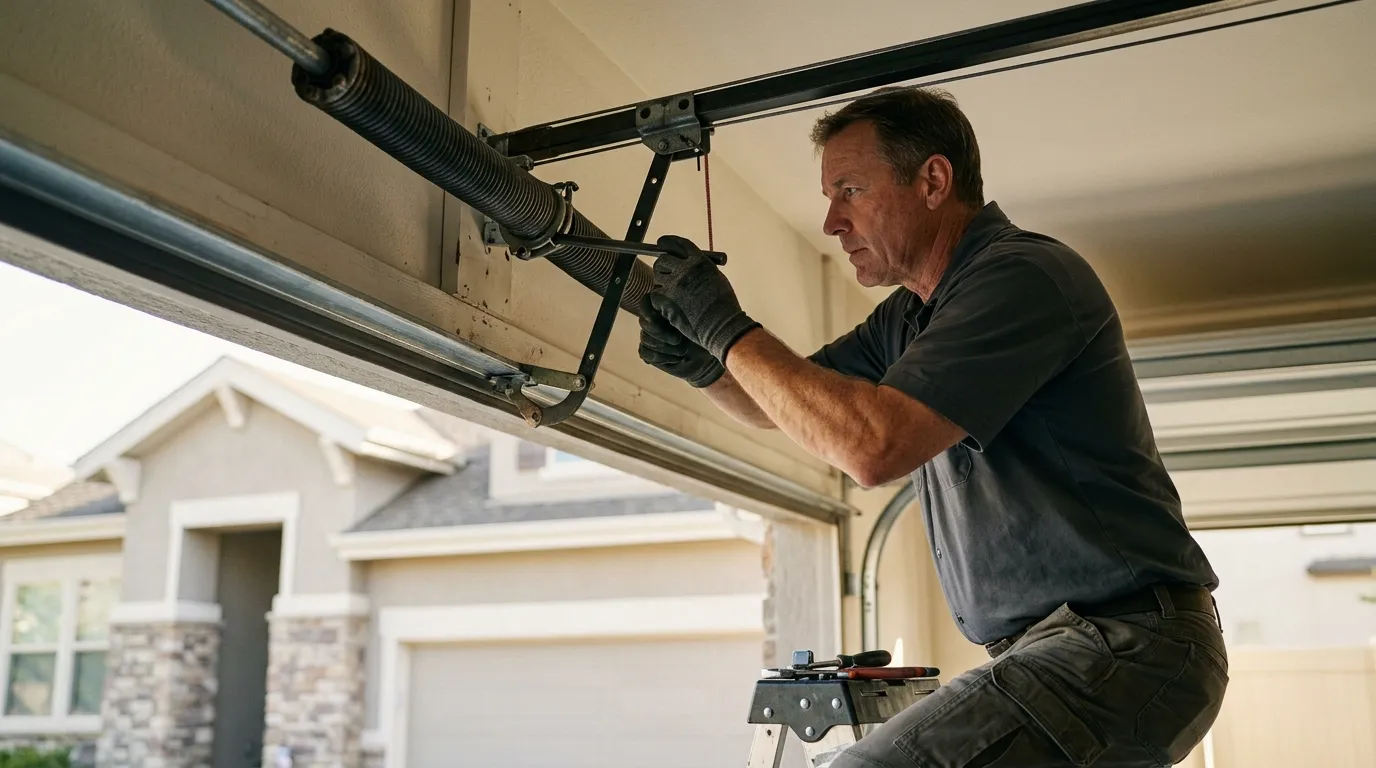
A torsion spring holds a lot of stored force, and on a door this age the spring, the cable, or the drum can be more worn than it looks. We don't recommend homeowners open the spring side of the door to adjust or replace it themselves - it's the single most common serious injury in this trade, and it's not a place to learn by trial. What you can safely do yourself: check that the track bolts are snug, clear the roller track of debris, and test the auto-reverse by laying a 2x4 flat under the door and closing it. If it doesn't reverse, stop using the opener and call someone. Lubricating hinges and rollers with a light garage-door-specific lubricant (not WD-40, which attracts grit) is fine and worth doing twice a year. Beyond that, if the door is off track, the spring is broken, or the opener is grinding, that's a job for a truck, not a Saturday project.
We travel to West University Place from Houston, about 6 miles out, so we're not a local depot with a truck sitting idle nearby - the drive is short but it's still a drive. We don't publish a fixed response window for this area because it depends on the day's route and what's already on the schedule out of Houston. What we can tell you: a broken spring or a stuck opener on a house this age is almost always a same-visit fix once we're there, since the hardware is common and we're not chasing down parts for something exotic. If the fix needs a special-order part - some early-90s opener models are no longer made - that's the one thing that can stretch the timeline past a single visit.
For a house built around 1991, the parts that fail most often are the torsion springs sized for a standard steel sectional door, extension cables, and mid-life openers from the chain and early belt-drive generation. We carry standard torsion springs and cables on the truck because they cover the bulk of what shows up on doors from this era. What we don't stock is anything specific to a discontinued opener model or a custom panel size - those get special-ordered, and we'll tell you upfront if that's the case rather than have you wait on a truck that doesn't have it. Given the income level and home values in this area ($250,001 median household income), a lot of these doors were upgraded once already since the original build, so what's on the door now may be newer than the house. We check what's actually installed before quoting a part rather than assuming it matches the build year.
If it's never been replaced, your door and its torsion spring are original to a system design from the early 1990s - steel sectional panels, torsion springs, and an opener that may lack modern safety sensors. Many homes in West University Place have had at least one door swap since then, so check for a manufacture label inside the top panel before assuming.
No. We're based in Houston, about 6 miles away, and travel to West University Place for service calls. There's no local depot here, so scheduling depends on the day's route rather than a fixed local response time.
Torsion springs are rated for a set number of cycles, typically 7-10 years of daily use, and most homes here are running springs original to a 1991-era build or a later replacement. Metal fatigue doesn't announce itself - the spring just lets go, often on a cold morning when the steel is stiffest.
Depends on the door's age and condition. If the panels are dented, the track is warped, or the opener is failing alongside the spring, replacement often costs less over time than repeated repairs. If it's just a broken spring or cable on a sound door, repair is the right call.
Call now or request a free quote - same-day service on most repairs, upfront written pricing.