Most houses across this part of Houston were built between 1956 and 2006, with the bulk of that stock going up in the 1980s and 90s across the 21 neighborhoods this shop covers, from Montrose and River Oaks to Lazybrook/Timbergrove and the Museum District. That spread matters here because an opener installed with a house built in the 80s is a different animal from one bolted in during a 2005 remodel. Chain-drive units from that older wave often still run fine, but their circuit boards and safety sensors weren't built with today's grid instability in mind. If your opener has run without a hiccup through the last few outages, leave it alone. Swapping a working unit for a newer one because it's old is money spent on a problem you don't have yet. The one thing worth checking, regardless of age, is whether the manual release cord actually works - pull it once a year so you're not learning it's seized the night the power drops and you need to get the car out.
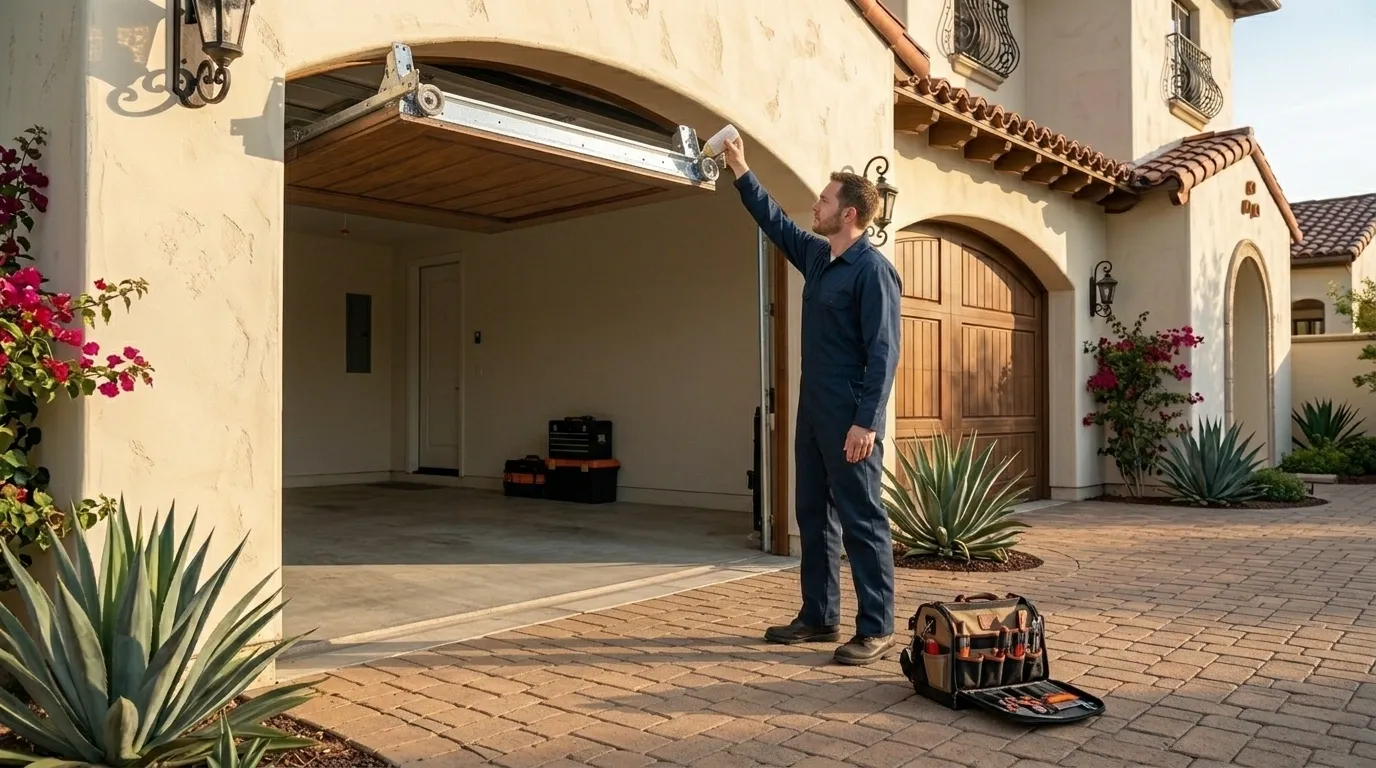
Houston sits in a mild climate band with occasional freeze risk, which sounds gentle compared to northern winters, but it means the electrical grid here takes hits from summer storms more than snow load. When the power cuts, a garage door opener with no battery backup simply stops - the door sits wherever it was mid-cycle, and the safety reversal sensors go dark with it. Across the roughly 84,125 owner-occupied houses in this service area, a large share still run openers without any backup battery, because that feature only became standard on units sold in the last decade or so. If your opener predates that, a power cut means the manual release lever is your only way in or out until the lights come back. That's not a defect, it's just how the hardware was built for its era.
Call if the door won't respond even after power is restored - that's usually not the outage itself but a board or capacitor that took a hit during the surge that came with it. Call if the manual release cord snaps or the trolley won't reconnect to the chain after you've pulled it; that's a five-minute fix for a tech and a frustrating one to force on your own. And call before you buy a whole-house generator setup sized around keeping the garage door running - for most owners here, a battery backup unit on the opener itself, or just knowing the manual release, covers it for a fraction of the cost. One honest limit: if your opener is old enough that the manufacturer no longer makes the circuit board, repair may not be possible at all, and replacement is the only real option - worth knowing before you spend on a service call for a unit that can't be fixed.
The mild-with-occasional-freeze pattern this area sits in means opener electronics rarely deal with hard cold, but they do deal with humidity swings and the surge risk that comes with storm-driven outages. Circuit boards in garages that run hot and damp for most of the year age differently than the same board would in a dry climate - solder joints and capacitors tend to go first. Given that most of the housing stock here dates to 1956 through 2006 with a median build year around 1986, a lot of openers in this area are old enough that their internal parts are simply worn from decades of that cycle, not from any single bad storm. If your door has started responding slowly to the remote, or the light blinks before the door moves, that's often the board telling you it's on its way out well before an outage forces the issue.
No, unless it has a battery backup, which only became common on units built in the last several years. Most openers in houses built before that just stop working mid-outage. Use the manual release cord hanging from the trolley to disconnect the door from the opener and lift it by hand until power returns.
Sometimes, but not always - it depends on whether the rest of the unit is in good shape. If the opener is old enough that parts are already wearing out, a backup battery is money spent extending a unit that may need full replacement soon anyway.
That's usually surge damage to the circuit board, not the outage itself. Storm-related power cuts often come with voltage spikes. If the door doesn't respond once power is restored, the board likely needs replacing rather than resetting.
Call now or request a free quote - same-day service on most repairs, upfront written pricing.