Most calls we get fall into a handful of patterns: a door that won't budge because a torsion spring let go overnight, a door that reverses halfway up because a roller jumped the track, or an opener that runs but the door doesn't move because the drive gear stripped. Sometimes it's simpler - a bent bottom panel from a car bumper, or a cable that frayed off the drum and left the door hanging crooked on one side.
Houston's housing stock runs from 1956 through 2006, with the bulk built in the 1980s and 90s across neighborhoods like Montrose, River Oaks, Lazybrook/Timbergrove, and the Museum District. That range matters because a lot of those original openers and torsion setups are still in place, decades past their expected spring cycle count. If your house sits in one of the older pockets near Downtown or Near Northside, there's a decent chance the spring on your door has never been replaced.
We look at the whole system before we touch anything - track alignment, cable condition, spring wind - because a door that looks like a broken spring sometimes turns out to be a bent track pulling the door off true. Fixing the spring and leaving the track bent just breaks the new spring faster.
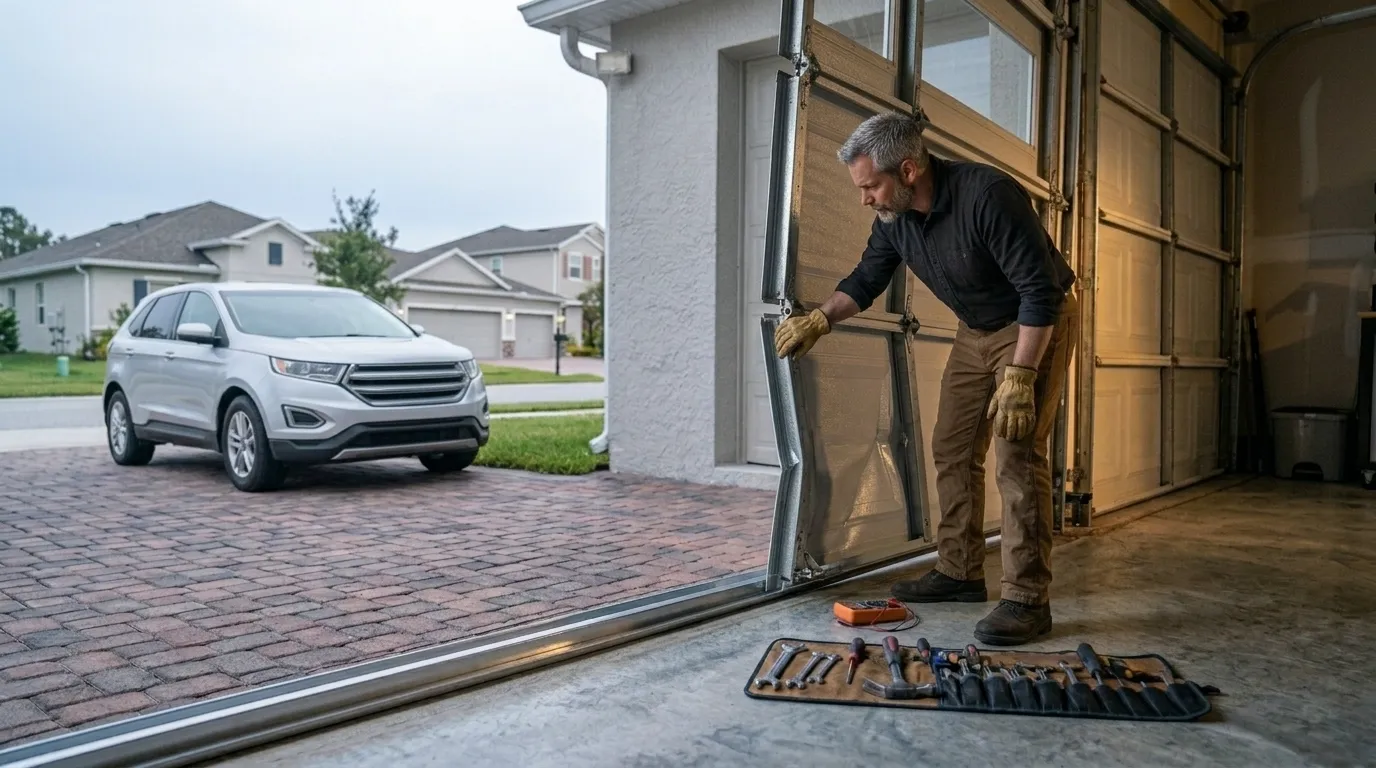
A single broken torsion spring on a standard door is usually a same-visit fix once we're on site - it's a matter of matching the wire size and wind direction to what's already on the shaft. Double doors with two springs, or a cable off the drum on top of a broken spring, take longer because we're resetting more of the system at once.
Where it stretches out is parts. Openers older than about 15 years, especially ones with a chain drive and a control board from a brand that's changed hands a few times, sometimes need a part we don't carry on the truck. In those cases we're honest about it up front rather than promising a fix we can't deliver that day - ordering a specific gear kit or circuit board can add a few days.
If your door is a total loss - wood panels rotted at the bottom, or a steel door dented past the point where straightening holds - replacement is faster and cheaper long-term than chasing repairs on a door built before 1990. We'll tell you when that's the case instead of billing you for patches that won't hold.
Lubricating hinges and rollers, tightening loose bolts on the track brackets, and clearing the photo-eye sensors of dust are all fine to do yourself and worth doing every few months. If your opener light blinks and the door won't close, check the sensors first - it's often nothing more than a spider web or a knocked-out-of-alignment eye.
What you should not do is touch the torsion spring itself. It's wound under enough tension to break a hand or worse, and there's no safe way to release or set it without the right bars and a clamp. We also don't recommend swapping cables yourself - a cable under load that slips off a drum can whip.
One honest limit on our end: we don't do same-day emergency service outside normal business hours for every call - if it's late and the door is stuck but the house is secure, it can usually wait until morning rather than paying an after-hours rate for a repair that isn't dangerous to leave overnight.
Houston sits in a mild climate with occasional freezes, not the deep-freeze cycling that cracks springs up north, but the humidity does its own damage. Steel hardware - springs, cables, track bolts - rusts faster here than in a dry climate, and rust on a torsion spring coil is what causes it to snap rather than just wear out gradually. That's a bigger factor in older housing near the core, where original galvanized hardware has had 30-plus years of Gulf Coast humidity to work on it.
Across the wider service area - more than 84,000 owner-occupied houses among 124,267 households - the mix runs from 1980s brick homes in inner neighborhoods to newer builds further out toward Jersey Village and Atascocita. Newer doors generally have better-sealed bottom weatherstripping and heavier-gauge springs, but they're not immune - a spring is rated for a cycle count, not a calendar, and a door used multiple times a day wears out regardless of age.
Heat is the other factor: attic-mounted openers in Houston garages run in higher ambient temperatures for more months of the year, which shortens the life of the motor and the capacitor inside it faster than in a milder climate.
We don't quote a flat price without seeing the door - spring size, whether it's one or two springs, and whether cables need replacing at the same time all change the cost. We give a firm number on site before doing any work, not an estimate that changes after we start.
Torsion springs fail on cycle count, not on a schedule, so they often let go with no lead-up. In Houston, humidity-driven rust on the coil accelerates the wear, which is why a spring that looked fine a month ago can snap overnight, especially on doors in older, inner-city housing.
No. A torsion spring holds enough stored tension to cause serious injury if it's released or wound incorrectly, and it requires specific winding bars and a clamp most homeowners don't own. This is one repair worth paying someone to do.
We cover the Houston service area including neighborhoods like Montrose, River Oaks, Near Northside, and out to places like Jersey Village and Atascocita. If you're unsure whether your address is in range, give us a call and we'll tell you straight.
Call now or request a free quote - same-day service on most repairs, upfront written pricing.