Spring Branch Central sits about seven miles west-northwest of downtown Houston, in a stretch of the city where the housing stock skews older than what you'll find further out. Across the wider service area, houses went up mostly between 1956 and 2006, with the typical build year landing around 1986, and that's the range we see most on calls out this way. Median household income across the service area runs $89,442, and the area counts 84,125 owner-occupied houses among 124,267 households total - a lot of long-tenure owners who bought the house once and are still fixing what came with it.
We don't have a landmark list or a street name to hand you here, and we're not going to invent one. What we do have is a good read on the doors and openers that shipped standard on houses built in this window, and that's what the rest of this page covers. If your door is original to a house from the 80s or 90s, chances are decent we already know what's wrong before we get out of the truck.
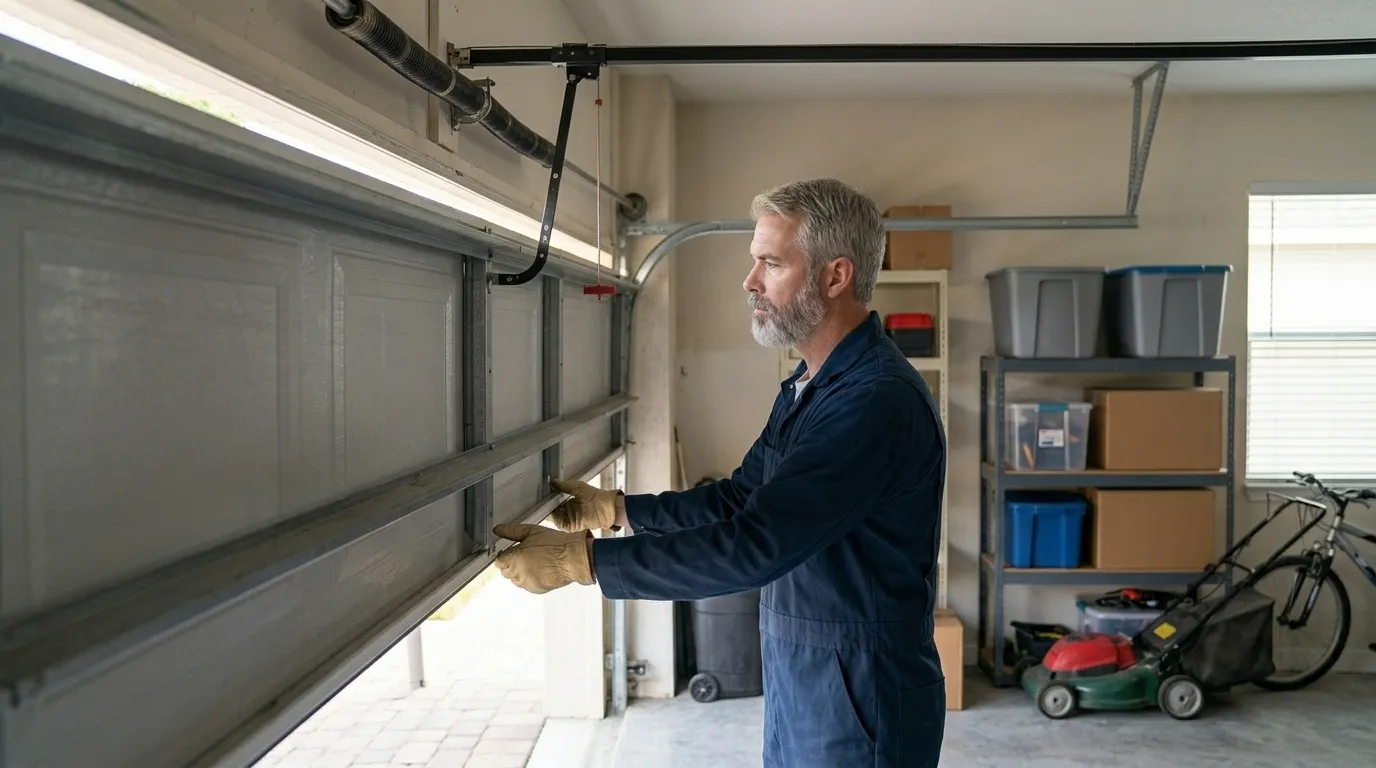
Houses from this era mostly came with steel sectional doors on extension or torsion springs, and openers that have usually been swapped once or twice by now since chain-drive units from that period rarely make it past 20 years without a motor or logic board failure. The most common call is a torsion spring that's given out on a double door - one side sags, the door won't stay up on its own, and the opener starts straining against dead weight it wasn't built to lift.
Rollers and hinges on doors this age are often the original steel rollers, which are loud and prone to binding once the track picks up a little rust from humidity. Track realignment after a light bump - a car mirror, a bike, a trash can - is a regular job too, since these panel doors flex more than people expect from steel.
We don't do the work if the door is a candidate for straight replacement rather than repair - a badly rusted bottom panel or a track bent past true usually costs more to patch than to swap, and we'll say so instead of running up a bill on a door that's not worth saving.
Housing in the wider service area was built mostly between 1956 and 2006, with the median build year at 1986, and that mid-80s-to-90s stock dominates across the named areas in this part of Houston. That means most garage doors and openers out here are second- or third-generation replacements on original framing, not original equipment - the door itself has usually been swapped at least once, but the header, track mounts, and jamb are often original 1980s lumber and hardware.
That combination shows up as a specific kind of repair call: a newer door or opener fighting an older, slightly out-of-square opening. Springs sized for a modern insulated door on a frame that's settled half an inch over three decades don't balance the way the spec sheet says they should. We adjust for that on site rather than installing to the box number and hoping.
The climate band here is mild with occasional freeze, which is enough cold on the coldest mornings to stiffen torsion springs and slow opener response, but not enough to make insulated doors or heated openers a standard recommendation rather than a homeowner's choice.
Spring Branch Central is roughly seven miles west-northwest of the city centre. Heading in toward downtown along that line, you pass through Shady Acres, about two miles northwest of centre, and Lazybrook/Timbergrove, about three miles northwest of centre, before you reach the denser, closer-in neighborhoods. We're naming those two only as directional reference points along the same general line out of downtown - not as adjacent streets or landmarks we're claiming to know block by block.
We don't have a landmark, cross street, or named subdivision for Spring Branch Central itself, and we're not going to guess at one just to make this section read longer. What we can say with confidence is the direction and distance, and that the housing era out this way lines up with the 1980s-to-90s stock that's typical across the service area. If you're on a street we haven't named here, that's fine - the door and opener history usually matters more than the exact address anyway.
Possibly, but it's less likely than you'd think. Steel sectional doors from that era typically last 20-30 years before a panel rusts through or an opener motor fails, so most houses built in the mid-80s have had at least one door or opener swap since. The framing and track mounts, though, are often still original.
Torsion springs are rated for a specific door weight and a specific number of cycles, and they wear out on a schedule regardless of how careful you are. If a spring on a 90s-era double door keeps failing faster than expected, it's often sized wrong for a heavier replacement door that went in later without a spring recalculation.
Both, depending on what's actually wrong. If a door is a straight torsion or opener repair, we fix it. If the bottom panel is rusted through or the track is bent past true, replacement usually costs less over time than patching, and we'll tell you that instead of billing for a repair that won't hold.
Call now or request a free quote - same-day service on most repairs, upfront written pricing.